How Ben Tuna turns fire-damaged Porsche cars into stained glass art
The LA artist has transformed a Porsche 356 and 911 S damaged in the wildfires into works of art
Copy link
Share on Facebook
Share on X
Share on LinkedIn
When LA stained glass artist Ben Tuna bought a rusty Porsche 911, little did he know it would inspire him to transform a fire-damaged Porsche 356 and 911 S into works of art exploring craft, history, loss and unexpected beauty
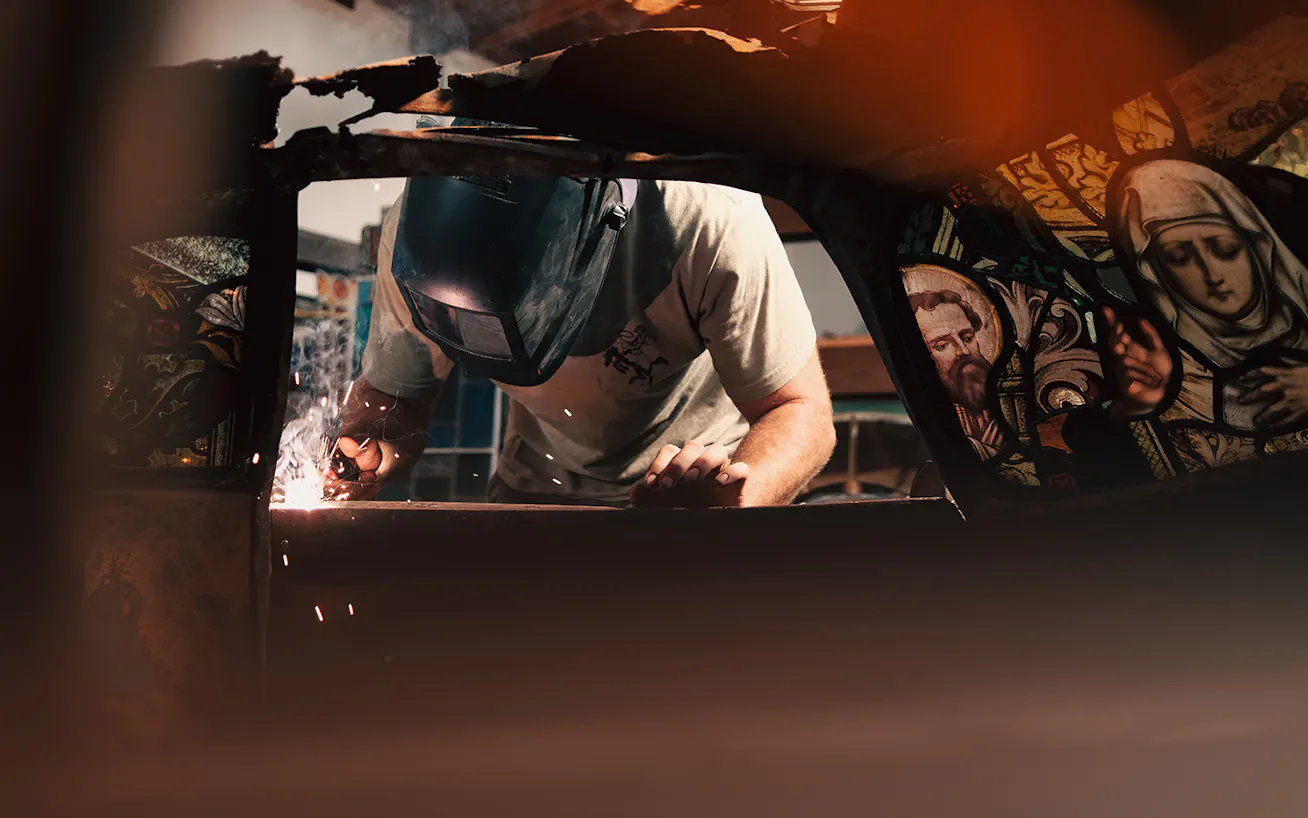
Fast facts: Ben Tuna’s stained glass Porsche artworksBen Tuna is an LA-based stained glass artist and car enthusiast His first Porsche artwork was created from the rusty shell of a classic 911 He later transformed a fire-damaged 1965 Porsche 356 and 1972 911 S using historic stained glass Both cars were severely damaged in the LA wildfires The artworks will be displayed at the 2026 Formula 1 US Grand Prix in Austin, Texas There once was a time when Ben Tuna harboured thoughts of becoming a kindergarten teacher. But life had other plans. After college, and in need of a job, Ben’s father invited him to work in the family glassmaking studio. What was initially intended as nothing more than a stopgap evolved into a career – and one which grew into a magical art project that has made his name. Ben Tuna studied at college to become a kindergarten teacher but instead joined the family glassmaking studio. This, in turn, evolved into creating unique art using stained glass Photo: Neal Lett @nealrlettHow did you become a glass artisan, Ben? “I grew up in a very artistic household where I always had access to materials like paints and clay – my mum loved just creating and my dad was a full-time glassmaker – so I could make anything I wanted. But I never really thought of becoming an artist myself. Instead, I went to school to become a kindergarten teacher. “After graduating, I needed a job and my dad hired me to work in our family studio when I was 21. That was 11 years ago – and I never left. It’s ironic because my dad never really wanted me to do it either. He used to say things like: ‘Oh, you can come in, you can work for me, but I don’t really want you in this business. It’s tough and it’s dirty.’ “I didn’t listen to him, though. I stuck around and learned. It became a passion of mine, and I’m still practising it today.” The idea for turning the shells of old Porsche cars into artworks came to Ben after a rusty 911 had been standing in his yard for months Photo: Neal Lett @nealrlettWhat does your glassmaking process look like? “There are many different types of glass. There’s hot glass, which is made by blowing glass. Then there’s warm glass, which is melted, and cold glass, which is what we work with at our family shop. “The glass comes in large sheets and we cut it by hand into whatever design we’re working on. My dad had a 50-year career in stained glass and mostly worked on restaurants and houses, as well as a few religious facilities. The work involved windows, lighting and high-end architectural pieces. We’d go into historical houses from the 1920s and 1930s across the country, either recreating original windows or designing new ones to fit the space.” Since Ben didn’t have a light table when working on the cars, he would follow his gut, picking out glass pieces then holding them up to the light before placing them in the artwork Photo: Neal Lett @nealrlettHow did you decide to use stained glass windows to make Porsche art pieces? “In America, glassmaking is considered a trade. It’s very utilitarian, a weird, thankless job where you just put the glass in, get paid and leave. People treat it like that, too – they look at stained glass windows as just something to fill a wall. But growing up in this artistic environment, I always saw glassmaking as something I poured my heart and soul into. It is a highly-skilled art form that takes years to master, and it’s so dynamic because it involves light, movement and colour. That’s why I started making stained glass art. I was getting bored of making pieces for people’s houses and not being recognised as an artist. “I got to a point where I wanted to create my own work, get more excited about the trade, and find my voice. I think I’ve achieved that over time.” How would you describe your artistic style? “I think it’s very typical of Los Angeles. It’s clearly influenced by the city’s architectural landscape and history. So it incorporates a lot of Spanish and Art Deco elements, for example. It is also very modern, with a Brutalist style rather than a classic, church-like one. “I’ve become obsessed with materials and I’m always searching for the most high-quality ones. All the old glass that I use is European. I have a warehouse full of it. My favourite type of glass is old German glass. There’s a studio in Munich that I recently visited. It’s the oldest operating studio around. It’s called Mayer of Munich [Mayer’sche Hofkunstanstalt], and it will celebrate its 180th anniversary next year. My father collected their windows for years and always sought them out. If there was an auction or one for sale in Europe, he would try to buy it. The way they paint faces, hands and fabric is very distinctive. Their work conveys the strongest feelings and the greatest sense of realism. They paint very emotionally. It’s just like how Germany makes its cars. “Then there’s the process itself. I have all my guys working without technology because I think that imperfection and the handmade element make our work look much better – more interesting and much more special. I’m a big fan of that wabi-sabi imperfection [a Japanese artistic aesthetic which celebrates the beauty of imperfection], which is great because it enables me to make unusual choices, such as lines not lining up or circles not matching. Those are the things that your eye picks out, and it makes the work look more interesting.” Ben’s stained glass Porsche art project has been such a success that the cars are heading to the US Grand Prix in Austin, Texas to be displayed over the F1 race weekend in October 2026 Photo: Neal Lett @nealrlettYour fire-damaged Porsche project made headlines all over the world. How did you get the idea for it? “The timing was really interesting. I actually made my first stained glass art car before the LA fires. I bought the car online late one night. I’m a car enthusiast, so I enjoy browsing car websites. On one of them, I saw a white, rusty shell of a 911. It had no floor or engine and was all beat up. It was in a warehouse, somewhere in Ohio or Indiana. I fell in love with it at first sight. At the time, I had no idea what I would need it for, but I bought it anyway because I had a feeling I would need it. The car ended up in my workshop and sat in my yard under a tarpaulin for a year. I kept looking at it, trying to come up with an idea. “One day, I started going through my glass and bought some old church windows. Then one day, I had an epiphany: what if we took one of those stained glass church windows and put it in the car? So we did. Soon after we finished the first car, the LA fires happened. “I saw all these cars that had been burned on Instagram, and they were all being taken away to the junkyard. I thought, wait a second! I had just repurposed an old 911 and turned it into a stained glass art car. I didn’t want people to scrap these cars because they’re precious. We couldn’t just get rid of them. “This was such a big tragedy in LA and affected most of the people I know, who lost either their homes, possessions or family members. I felt inclined to do something positive out of something so terrible and sad. “A friend of mine knew someone who lost two Porsche cars in the fires, so I sent him a message saying: ‘I have this idea. I want to put glass in the cars.’ He let me do it. We sent a trailer to pick up the burnt-out cars and took them back to a lot. We cleaned them all up and cut everything out. Then we removed all the ash, washed them and brought them to the studio to begin the process of filling them with glass. One was a 1965 Porsche 356 and the other a 1972 Porsche 911 S.” Ben feels passionately about repurposing old Porsche cars instead of sending them to the junkyard – a fate, he says, that these cars don’t deserve Photo: Neal Lett @nealrlettHow did you come up with the design of the glass that went into these cars? “Light plays a significant role in stained glass work. It’s what brings the artwork to life. For these windows, I didn’t have a light table in the studio, so I built them piece by piece. I would look at each piece in the light, then cut it and put it down before looking at the next piece. “There’s a spiritual element to it, given that I was dealing with such historically and emotionally significant materials. It was almost like a sixth sense, guiding my creative process. The glass was 150 years old and the cars were 50 or 60 years old; they had been in someone’s family. I felt almost like a conduit, simply creating without a plan. “Once I looked at the finished piece, I started to see all these incredible connections between the different elements that had just happened naturally. For example, one face is looking at a figure over here, who is looking down at a goat, which is over there. Many stories emerged from these pieces unintentionally. “What’s interesting about my work is that the audience can interpret it in any way they want. I think that’s why it’s been so successful with viewers – you can have a four-year-old child standing next to an 89-year-old, and they’re both going to look at it and say, ‘This is so cool!’. “There are so many little details that some people cry when they see it. There’s a strong emotional connection between the fine church glass and the rough metal. You can see the dialogue between the two materials in the work.” In the future, Ben plans to create more sculptural stained glass pieces – like light fixtures, for example. And he will always keep experimenting, he says Photo: Neal Lett @nealrlettWere you always a car guy or is this a recent development? “I've always been interested in cars. As soon as I turned 16 and got my licence, I went to car shows every weekend. “The cars I own now are my absolute favourites. For example, I have a yellow 1975 Porsche 911 S with a fully refurbished interior. I also have an orange pick-up truck. All my cars are brightly coloured. I love everything yellow and orange. “I became interested in Porsche because of the feeling you get when driving one. Every time I’m in my Porsche, I think this car doesn’t need anything more. It was made in 1975, and they had everything figured out back then. Everything works perfectly. Everything makes sense. “The 911 is very logical. It’s a minimalist design, but a refined one where you don’t need anything else. There are no unnecessary gadgets. There’s nothing extra connected to it. It’s just you, the car and the road, which I think is a very wonderful experience for a purist like me.” If you had to finish the sentence, “To me, Porsche is…”, what would it be? “That’s hard. Certainly, I think Porsche is a car for creatives – artists, architects and people who appreciate the process, technical side of things and the composition. “People buy them for the experience of driving one – it’s all about the history and heritage.”
Find your Porsche inspiration
Create your Porsche
Continue reading
A guide to baseball player Shohei Ohtani, Japan’s World Series-winning hero
With unique skills with both bat and ball, the Japanese baseball star is taking his sport to a whole new level. Find out how on a Porsche Taycan road trip in LA
Read more
The Stuttgart Ballet and Porsche continue their successful partnership and reflect on Ballet in the Park
Following the 20th anniversary edition of Ballet in the Park, Porsche and the Stuttgart Ballet are looking ahead to the 2026-2027 ballet season and the next chapter in their long-standing partnership
Read more
Sportscar Together Day 2026: the best moments in pictures
From early morning meet-ups to memorable drives on favourite roads, Sportscar Together Day brought enthusiasts together around the world on 12-13 September 2026. Discover some of the standout moments from the weekend
Read more