What happens when you photograph a Porsche 356 SL with a period Leica?
A 1951 Porsche and Leica reunited through analogue photography
Copy link
Share on Facebook
Share on X
Share on LinkedIn
A historic Porsche, a vintage Leica and photographs straight from the lab, without added contrast or sharpening. How a carefully planned shoot produced an image its photographer never saw coming
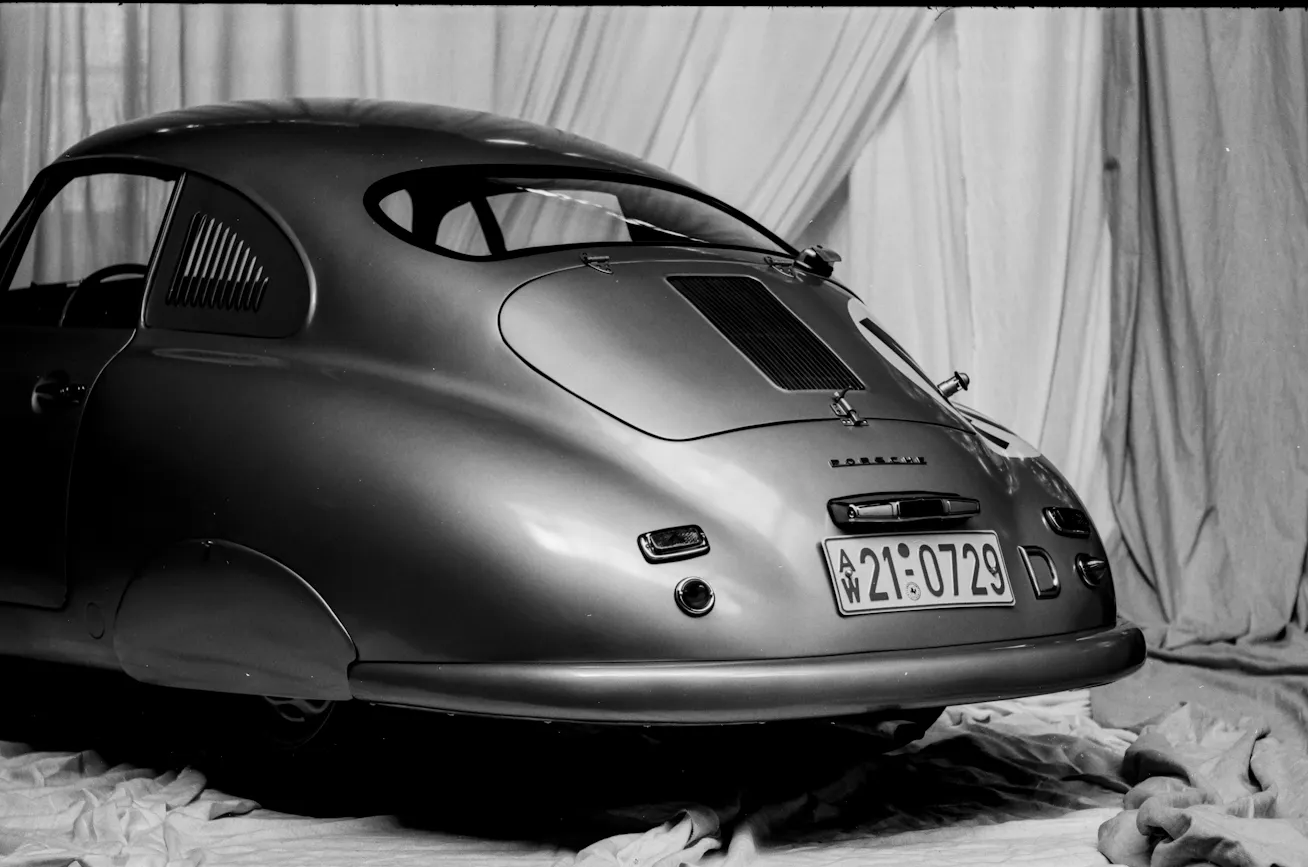
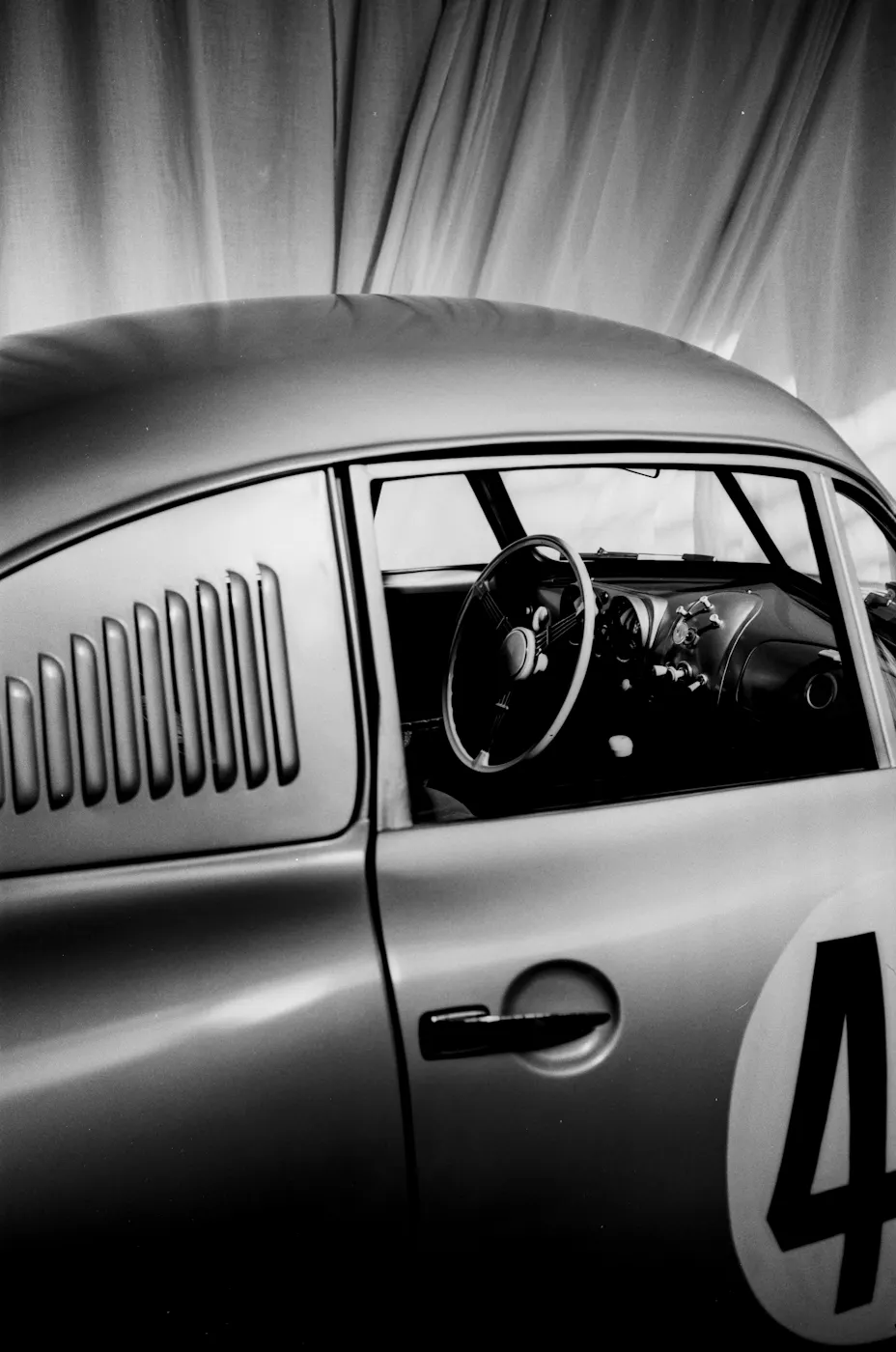
Porsche 356 SL photography: the Leica shoot explainedWhat was the idea behind the Porsche and Leica shoot? Photographer and Leica ambassador Philipp Reinhard photographed the 356 SL, the first Porsche to achieve a class win at Le Mans in 1951, using a Leica lc from the same year. He chose black-and-white film and a former workshop in Stuttgart to create a series of stunning photographs that would be difficult to date.How did shooting on film change the creative process? An unfamiliar camera, fixed focal-length lenses and MONOPAN 50 black-and-white film encouraged Philipp to measure, compose and consider each exposure carefully. Because the viewfinder was separate from the lens, he discovered the precise reflection in his favourite photograph only after the film was developed.How were the photographs finished? Philipp used the lab’s scans without adjusting contrast, tones, grain or sharpness, or applying lens correction. Apart from possibly trimming a film border from one frame, he left the photographs uncropped. Physical prints were made directly from the negatives in a darkroom.The results of a meeting between a classic Porsche 356 SL and a period Leica analogue camera Photo: Philipp Reinhard | PorschePhotographing the class-winning Porsche 356 SL Le Mans race carWhen the Porsche 356 SL that won its class at the 24 Hours of Le Mans in 1951 returned to France from its current home in the United States, photographer and Leica ambassador Philipp Reinhard had a rare opportunity.During its visit to the 2026 24 Hours of Le Mans, the car was in Stuttgart for a short time before travelling back home to its owner. Which is how Philipp ended up with the car for a day in order to photograph it.His plan was to use a Leica from 1951 – the same year as the car’s class-winning debut Le Mans victory – and shoot on black-and-white film to create images that look like they could have been taken when the car was brand new.The production came together in less than two weeks, but while the planning moved quickly, making the photographs required a lot of patience. Philipp had to measure distances, check the light and compose the shots through an unfamiliar viewfinder. The vintage Leica camera didn’t have a screen to tell him whether an exposure had worked either.But, for Philipp, the hardest part of all was waiting for the results of the shoot. He sent the film to the lab as soon as the production wrapped, requesting a rush service. When the email arrived announcing that the scans were ready, he immediately began downloading them. But with 60 gigabytes of files, the download kept stalling.So he anxiously emailed the lab again. “Just give me a heads-up that the files are looking good, that the scans are all right and that everything is fine with the pictures,” he says.He had hoped for ten or 15 good photographs. In the end he had so many to choose from – and his favourite would turn out to contain a reflection he hadn’t seen when he pressed the shutter.The brief visit that the Porsche 356 SL made to Stuttgart gave Philipp Reinhard the opportunity to photograph it with a period Leica Photo: Philipp Reinhard | Porsche75 years of history The historic 356 SL was due to spend a week at a Porsche Museum storage facility in Stuttgart before returning home.That meant there was time for a quick shoot, provided everything could be brought together quickly. The ambition was simple: photograph the car using a Leica camera from 1951 and try to produce a set of images that would be difficult to date. First stop was the Leica archive at its headquarters in Wetzlar, Germany, to select a camera from the same year.“You can look at the pictures in 15 years and you may not know: are they 85 years old, are they new, are they 50 years old?,” he says.Philipp’s journey into analogue photography began when he was skateboarding during his youth. “In skateboarding there was never a lot of money, and all the skate photographers – the legends, some of my childhood heroes – most of them had a Leica M6.”When he met one of those photographers and tried their Leica camera, he understood the appeal. “I knew there was something different from my own camera back then,” he says. “The Leica wasn’t plastic, it was metal.”“For the first ten years, I only shot on film,” Philipp recalls. “For me, this production was a little bit like going back in time. You could call it a full-circle moment.”A classic pairing: a Porsche 356 SL photographed on a Leica from the same era Photo: Philipp Reinhard | PorschePorsche and Leica: two objects built to lastWhat struck Philipp about the Porsche and the Leica was how well both had endured the passage of time. “They’re both very well built. The quality is outstanding – to have objects this old that you could easily rely on in everyday use. The car, the camera… it just felt right.”He has experienced that lasting appeal with his own Porsche. Around nine years ago, he bought a white 911 Targa (G-Series) with blue leather inside, a car reimported from the US. It now has nearly 250,000 km on it and, he says, still works “like a charm”.“I thought, after the first one or two years, maybe I want to have a different car because I’ve seen it enough. But the total opposite happened,” he says of the enduring appeal of his 911. “Year by year, I fell more in love with the car. You build a real emotional connection to a car like this.”In the studio, the 356 SL gave him plenty of details to explore and capture. “I fell in love with the split window. I really love the moon caps [wheel covers] – this is something you never see in everyday life. I also love the leather straps.”Period details such as the chassis number and its small engine were further attractions, too. On the bonnet and doors, the racing numbers were painted by hand: “You could really see how this was done.”Using a camera from the car’s era encouraged him to imagine how someone might have photographed it when it was new.The racing numbers, leather straps and split windscreen were among the details that caught Philipp’s eye Photo: Philipp Reinhard | PorscheShooting with a classic Leica lc cameraAlthough film was a familiar format to Philipp, this particular Leica lc camera wasn’t.He measured the distance to the car and set it on the lens. He metered the light. He composed the shot through a finder separate from the lens, aware that his view differed slightly from the one the film would record.For one exposure, he even used his ears. Wanting to hold the shutter open for around one-eighth of a second, he listened to a digital camera set to that speed, then practised reproducing the interval by hand on the Leica.He stayed with the same black-and-white film throughout the shoot and resisted introducing different film speeds or colour film. “The limitation we had was in the end a very big creative freedom,” Philipp says. “Every picture is carefully composed, and you always need to think a lot about it.“I really love photography, but digital sometimes feels like work,” he adds. In his free time, he usually chooses an analogue camera. And with his digital camera, he’s tried to impose similar discipline on himself. Away from assignments, he sometimes heads out promising to take no more than 50 photographs.“To be honest, it never works that way,” he says, admitting that he comes back with many more images that he intended.Measuring distances and metering the light inspired Philipp to consider each exposure before pressing the shutter on the analogue Leica camera Photo: Philipp Reinhard | PorschePorsche photography on filmThe Leica’s old lens gave the photographs a distinctive softness, particularly where light reflected off the car’s bodywork. “The lens coating was different,” Philipp explains. “It was very, very thin. A modern lens would look different. It would work differently with the light.As a result, he says, “the pictures may not appear totally perfect, but they have that 1950s charm”. He felt the same about the texture of the film: “It’s not a massive grain. It’s just something I think is very charming.”Philipp believes the car photographed better on film. “Maybe it’s because of the lens, maybe it’s because of the material, maybe it’s just a mix of very different points we cannot really pinpoint,” he says.He describes that there was “a little bit of magic in the room” during the production. “Bringing the original car, period camera and a small crew together,” he says, “gave us a really warm and thankful feeling when we wrapped up the day.”Philipp valued the vintage lens’ softer highlights and the texture of black-and-white film Photo: Philipp Reinhard | PorscheThe Porsche photograph he didn’t expectThe set was designed to work with the car’s age and lightness. Inspired by fashion photography, curtains surrounded the Porsche. The former workshop in Stuttgart also provided a setting sympathetic to the car’s age, with daylight entering through a large roof window.But Philipp couldn’t fully control that light. After lunch, the sun reached an angle that sent stripes of brightness and shadow across the set. One of the resulting photographs became his favourite, with the light reflecting off the car’s roof and windscreen in alternating bands of light and dark.The separation between the viewfinder and lens meant he hadn’t actually seen that precise arrangement when he took the photograph. “We only saw it when the pictures were developed and scanned,” he says. “That was a very nice surprise.”Philipp’s favourite photograph from the Leica shoot was captured almost accidently when a skylight allowed the sun to light up the car Photo: Philipp Reinhard | PorscheThe final resultsThe lab’s reply to his anxious email was brief: “Pictures looking great.”That was the first relief. Philipp then managed to open a small batch of files while the rest continued downloading. As he worked through the photographs, he realised how much more he had than the handful of successful images he’d hoped for.“Every picture is in focus. Every picture is something special. Every picture feels magic,” he recalls.Later, a print specialist accustomed to working with negatives examined the photographs. “He couldn’t really believe it,” Philipp says. “He asked us, ‘Was it really shot with a camera this old and a lens from the same age?’”Philipp adds: “For me, it was really one of the most intense, most passionate projects I’ve ever worked on.”Philipp hoped for ten or 15 successful photographs; choosing the final selection proved harder than he expected Photo: Philipp Reinhard | PorscheStraight from the lab“I really thought we’d have to do something in [photo editing software] Lightroom – that we’d have to retouch a little bit,” Philipp says. “But there is really nothing done to the pictures.”There were no changes to contrast, blacks, whites, highlights or mid-tones. No grain reduction, sharpening or lens correction either. And, apart from possibly trimming a film border from one frame, no cropping.“These pictures are as raw as it gets,” he adds.He used Lightroom to select photographs, and that proved difficult enough. A selection of 15 hero images was agreed. Then, shortly before publication, Philipp returned with another 15 he wanted considered.“I’m pretty sure there are five bangers. They would always be in the selection. But probably we would choose a couple of different ones now,” he says.Curtains brought a fashion photography feel to the set, while daylight entered through the workshop roof Photo: Philipp Reinhard | PorscheDeveloping car photography on paperFor the physical prints, the process returned to the negatives. Philipp describes the darkroom: a negative placed in an enlarger, light projected onto photographic paper for around 30 seconds, the printer using their hands to shade areas and control the exposure. The paper is then processed through chemical baths and washed.These prints are made from light passing through the original film not a digital printer.“It’s a totally raw, old school, original workflow,” Philipp says, “from the photography to the final picture on paper.”Some of the prints will be sent to the owner of the 356 as a thank you for the opportunity to photograph their car in this unique way. Philipp, meanwhile, is figuring out how he can make the most of the many others from a photo shoot that delivered more than he could ever have imagined.
Build your perfect Porsche
Build your Porsche
Continue reading
How Ben Tuna turns fire-damaged Porsche cars into stained glass art
When LA stained glass artist Ben Tuna bought a rusty Porsche 911, little did he know it would inspire him to transform a fire-damaged Porsche 356 and 911 S into works of art exploring craft, history, loss and unexpected beauty
Read more
A guide to baseball player Shohei Ohtani, Japan’s World Series-winning hero
With unique skills with both bat and ball, the Japanese baseball star is taking his sport to a whole new level. Find out how on a Porsche Taycan road trip in LA
Read more
The Stuttgart Ballet and Porsche continue their successful partnership and reflect on Ballet in the Park
Following the 20th anniversary edition of Ballet in the Park, Porsche and the Stuttgart Ballet are looking ahead to the 2026-2027 ballet season and the next chapter in their long-standing partnership
Read more